OUR MAIN SERVICE
Garage door repair in Overland Park, diagnosed from the failed part
Chips: Broken springs · Snapped cables · Off track · Worn rollers · Bent sections
A door that will not open is holding your car, your tools, or your morning hostage, and it rarely picks a convenient day. Metcalf Garage Door is a family-run repair crew working Johnson County out of south Overland Park. Call, and Carla will get the story of what the door is doing; most Johnson County calls are seen the same day. At your house, you hear the diagnosis and the full price before any repair begins, and the diagnosis names the part that failed, in plain words. Start with a free, no-obligation estimate.
The failures we see every week
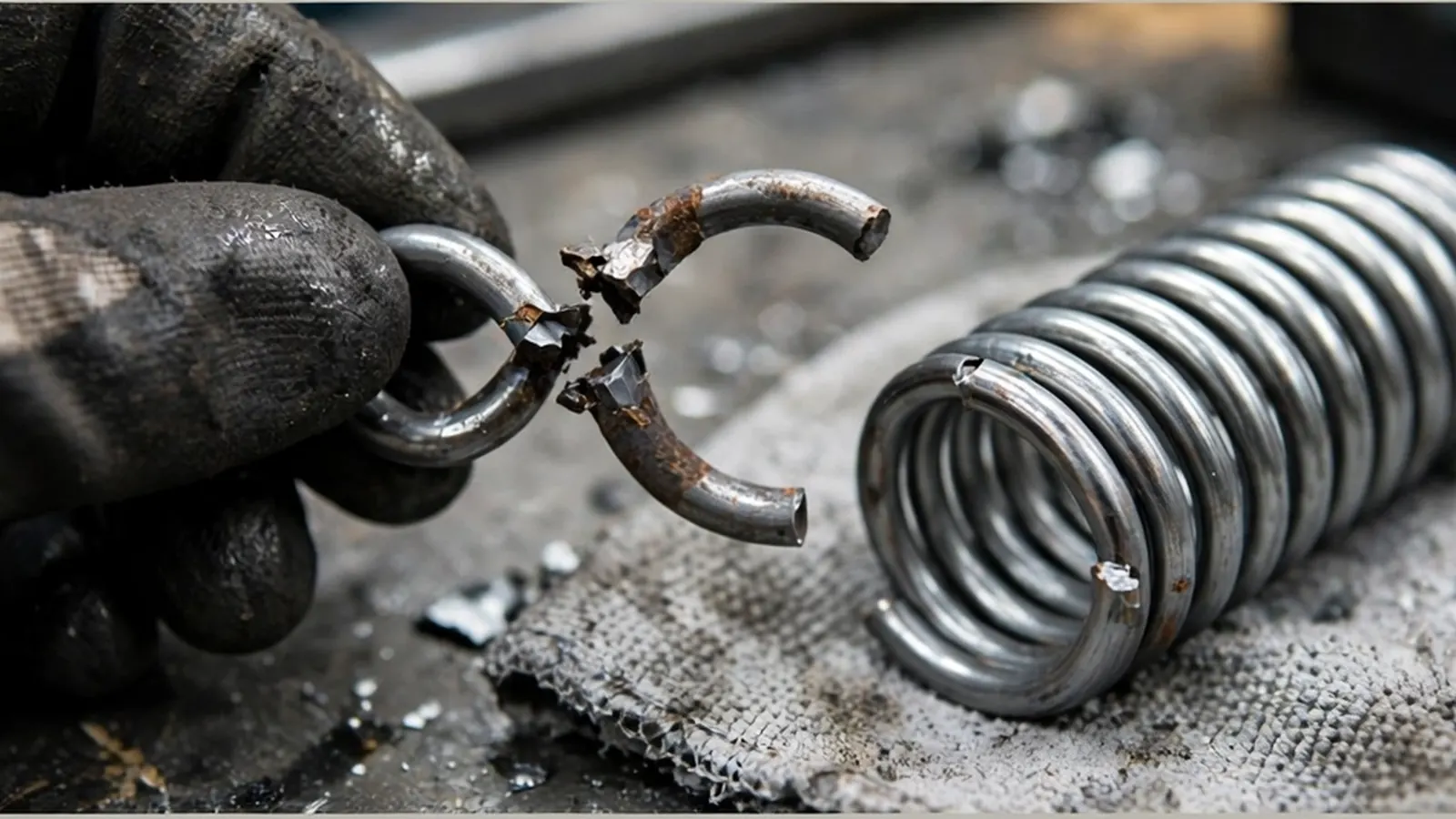
A spring, snapped
The bang people describe as a car backfiring in the garage is almost always a torsion spring letting go. The springs are the muscles of the system; they carry the door's weight so the opener only has to guide it. A door with a broken spring feels impossibly heavy because, for the first time, you are feeling all of it. Do not keep working the opener against it. The motor was never built to lift the whole door, and forcing it trades a spring job for a spring job plus an opener.
Cables, frayed or snapped
The cables run from the bottom of the door up to the drums the springs turn, and they live a hard life down at floor level: road salt, meltwater, and Johnson County winters. A cable strands and frays one wire at a time, then lets go all at once, and the door drops crooked into its tracks. A cable hanging loose, or a door sitting visibly tilted, is a stop-using-it signal. The remaining cable is holding more than it was hired to hold.
A door off its track
Bumped by a bumper, dragged sideways by a failing cable, or racked by a slab that heaved over a clay-soil winter, a door can climb out of its tracks and jam at an angle. Off-track doors are wedged under spring tension, which is why the guidance everywhere is the same: leave it where it sits and call. Forcing it back by hand bends tracks and sections that were fine a minute ago.
Rollers worn flat
A door gets loud by degrees. Steel rollers wear oval, nylon rollers crack and shed their bearings, and the door starts to sound like it is coming down a gravel road. Noise is the system's early-warning channel, and rollers are usually its first message. A set of worn rollers also works the opener harder on every cycle.
A section, bent or rusting through
Backed into, caught by a ladder, or rusting along the bottom rail where winter slush sits against it, a damaged section is sometimes a section job and sometimes the start of a bigger conversation. Insulated steel sections bend and stay bent. Wood sections swell in a humid Kansas summer and stick in the opening. Either way, whether your door's sections are still made decides the repair, so ask that question first.
A door that will not stay down
It closes, thinks about it, and rolls back up. Or it never quite reaches the floor. Misaligned photo eyes, a travel setting that has drifted, or a bottom seal swollen out of shape can all do it, and so can a door whose balance has changed as its springs aged. A door that will not stay closed is a security problem wearing a mechanical costume, and it is worth fixing the day you notice it.
What garage door repair typically runs in Johnson County
Use this table to budget. It is not a quote, and it cannot see your door from here. Your price comes after the diagnosis, covers the whole job, and is yours to accept or turn down before any work starts.
| Repair | Typical range | Usual time |
|---|---|---|
| Broken springs, the pair, installed | $275 to $500 | 45 to 90 minutes |
| Snapped cables, the set | $150 to $300 | About an hour |
| Door off track, reset and aligned | $150 to $350 | 1 to 2 hours |
| Rollers, full set replaced | $120 to $220 | About an hour |
| Damaged panel section | $400 to $800 | Half day, may need ordering |
| Most other repairs | $150 to $400 | Varies |
Why the ranges are wide: Johnson County hangs everything from a light single-car door in Mission to a tall, insulated three-car door in south Overland Park, and a spring set is priced by the weight it has to carry. Heavy doors cost more to fix honestly than light ones. A suspiciously cheap spring quote has usually sized the spring to the price instead of the door. Ask what weight the new springs are rated for, and check the answer against the door hanging in your garage.
Think of the door as a system hanging in balance
Paul spent eleven years installing these doors, and it changed how he hears a repair call. A garage door is not a wall that slides. It is a few hundred pounds of steel or wood hung in careful balance: springs sized to the door's weight carry nearly all of it, cables transmit that lift evenly to both sides, rollers just guide the travel, and the opener's whole job is to manage the movement, fifteen pounds of push or so on a balanced door.
Most failures are the balance breaking somewhere. A spring weakens, the opener inherits weight it cannot carry, the gear inside it wears, the door starts down crooked, a cable takes a load it hates, and the homeowner hears the story as a bang, a groan, or a door sitting tilted on a Tuesday. That is why the first question on our calls is never "what part," it is "what did it do." The behavior tells us where the balance went. When you describe your door's problem to any company, describe the behavior, the noise, the angle, the last normal day. You will get a straighter diagnosis for it.
Why this crew, for this job
The failed part tells the story
Whatever comes off your door gets named for what it is, alongside the bill. A cracked spring and a worn gear explain the diagnosis better than any invoice line. Keep that standard with every company you ever hire for this door.
Know the price before the tools come out
The diagnosis and the full price are explained at your door before the repair starts, and the estimate itself is free, hassle-free, and no-obligation. If the number is wrong for your budget, that is the end of it.
Ask how the door was installed
A share of repeat failures were born on installation day: a spring a size light, a cable seated carelessly, hardware left loose to save twenty minutes. When a door fails young, it is fair to ask whether the repair is fixing a worn part or an old shortcut. The answer changes what should happen next.
A trapped car goes first
Tell Carla if your car is inside. A door we cannot open is an inconvenience; a car you cannot drive is a day going sideways, and the schedule bends for it. That is a routing decision we are glad to make.
How a repair call goes
- You describe the door. Call Call for same-day help or send the estimate form: the noise, the angle, when it last worked. Carla books the window.
- The door gets read like a system. Springs, cables, rollers, tracks, and opener together, because the loud part is not always the broken one. (Guidance for any company you call, not just us.)
- You hear the price, then decide. Diagnosis and full price first, tools second. Approve it, trim it, or turn it down.
- The door runs, start to finish. Full open and close cycles before we leave, and the failed parts named for what they are.
Overland Park doors, and how they age
The county's doors age in two accents. Up north, in the postwar cities along the Shawnee Mission edge, doors live in single-car and detached garages, often the original door or its first replacement, with cables and bottom rails wearing against decades of winters. Down the Metcalf corridor and into south Overland Park, Olathe, and Lenexa, the growth decades hung wide, tall, insulated doors by the subdivision, and those doors are reaching spring age together. Add the county's clay soil, which swells and shrinks enough to rack a frame out of square over the years, and you have the Johnson County repair picture: honest doors, predictable failures, and a lot of them arriving in the same neighborhoods at the same time. Local detail for each town is on the service areas page.
Repair questions
My door opened crooked and stopped. What happened?
One side lost its lift: a snapped cable, a cable off its drum, or a spring that failed on one side of a two-spring door. The opener usually gives up quickly, which is a mercy. Leave the door where it sits; it is wedged under uneven tension, and straightening it by hand is how sections get bent.
Can I keep using the door with one broken spring?
On a two-spring door, the surviving spring is now carrying a whole door it was sized to share, and the opener is carrying the difference. Every cycle spends the second spring faster and loads the opener's gear. It will open, for a while, the way a car will run on a spare tire: to get you to the repair, not to live on.
Why does the price depend on weighing my door?
Springs are not sold by the door's size; they are rated for its weight, and two doors with identical dimensions can differ by a hundred pounds once insulation, windows, and wood enter the picture. A spring rated light lifts less and dies young. Any company quoting springs without asking about the door's weight and build is pricing a guess.
The bottom of my door is rusting. Repair or replacement?
A rusting bottom section is often replaceable on its own if your door's model is still in production, and the bottom rail and seal are exactly where Kansas winters do their work. If the rust has climbed into the second section, or the model is long discontinued, the honest conversation gets bigger. Ask whether your sections are still made before approving anything.
How do I know the new springs are the right size?
Ask three questions of whoever does the work: what weight are they rated for, what cycle life are they rated for, and why did the old springs give out when they did. Right answers exist for all three, and a company that sized the springs to your door will answer without pausing. It is the same receipt-checking habit as the diagnosis.
Door out of balance with your morning? Call for same-day help or start with the free estimate. Most Johnson County calls are seen the same day.